Dr. Alain LeRoy Locke (1885–1954) was an American philosopher, educator, writer, and cultural theorist universally celebrated as the “Dean of the Harlem Renaissance.” As the first African American Rhodes Scholar and author of The New Negro (1925), Locke provided the philosophical blueprint for modern Black aesthetic, intellectual, and cultural self-determination.
The Intellectual Architect of the Harlem Renaissance: Alain Locke
Born into a cultured African American family in Philadelphia, Alain Locke was an intellectual prodigy. After graduating from Harvard University with honors in philosophy and literature, Locke made international history in 1907 by becoming the very first African American selected as a Rhodes Scholar to study at Oxford University. Facing overt racial prejudice from American classmates at Oxford, Locke stood firm, continuing his advanced studies at the University of Berlin before completing his Ph.D. in philosophy at Harvard.
Joining Howard University as chair of the Department of Philosophy—a post he held for over three decades—Locke became the ideological catalyst for a generation of young Black writers, painters, sculptors, and musicians congregating in Harlem during the 1920s. Locke argued that African Americans must no longer see themselves as social problems to be solved or pitiable victims of prejudice, but as creative, self-confident contributors to world civilization who define their own cultural identity through artistic excellence.
Profound Alain Locke Quotes on Culture, Art & Black Excellence
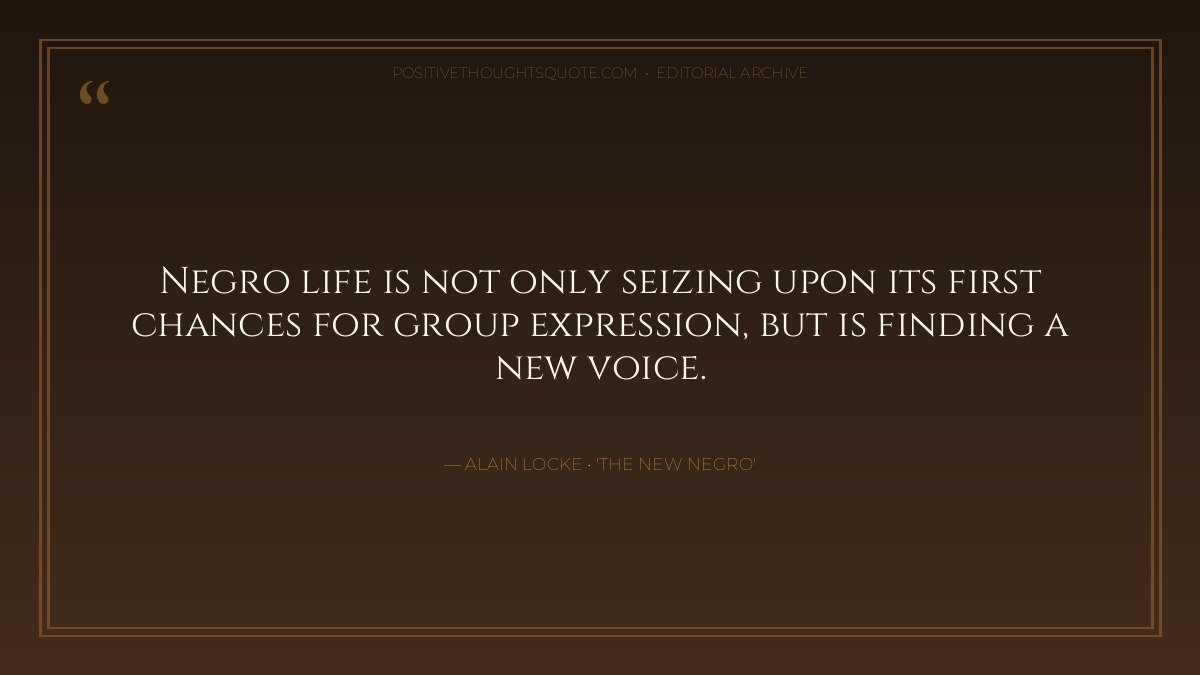
- “Negro life is not only seizing upon its first chances for group expression, but it is taking its first chances for group development. We are now witnessing the spiritual coming of age of the New Negro.”
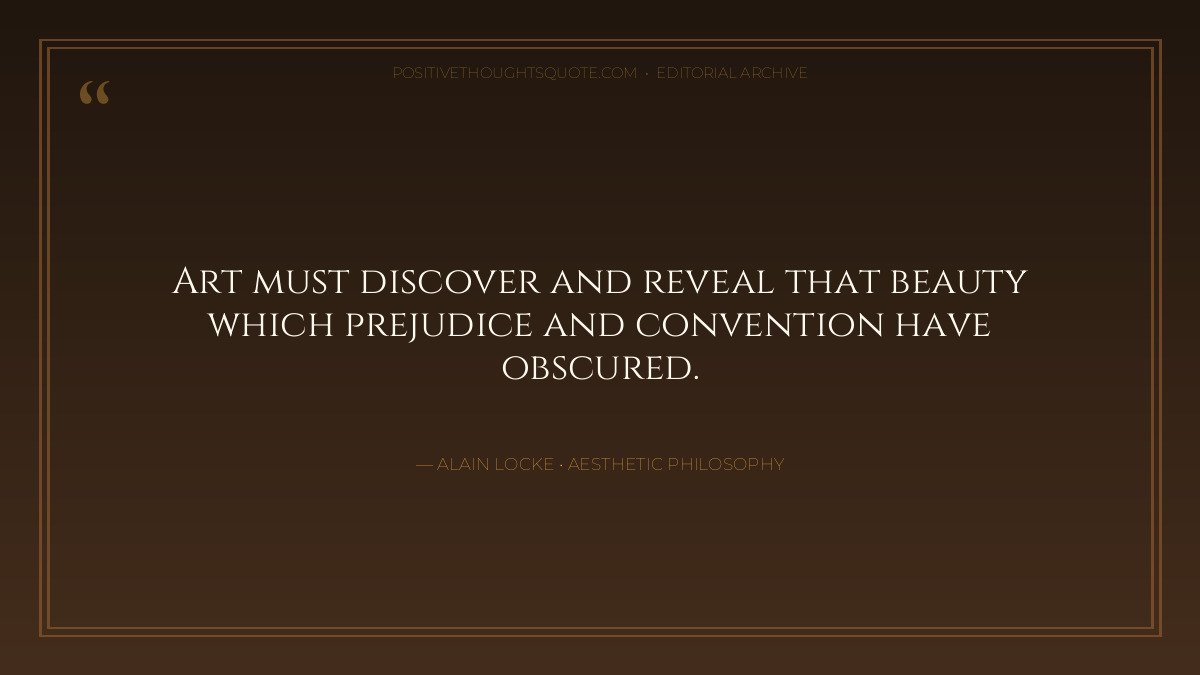
- “Art must not be a mere carbon copy of another culture; it must be the fearless, authentic projection of our own ancestral soul, pain, and triumph.”
- “The pulse of the contemporary Negro world beats in the streets, in the jazz halls, in the poetry, and in the canvas of artists who dare to tell the unvarnished truth.”
- “True education does not train you to assimilate into existing prejudices; true education frees your mind to create new standards of excellence.”
- “We have spent centuries being studied as a social problem. It is time we are recognized as creators of culture, beauty, and philosophical depth.”
- “Cultural pluralism is not the fragmentation of a nation, but the rich, harmonious symphony of diverse voices contributing to the common human enterprise.”
- “In the realm of beauty, there is no caste, no race, and no boundary that the creative human spirit cannot transcend.”
- “Self-respect is the foundation of all genuine progress. A race that does not revere its own roots will never bear durable fruit.”
- “Jazz is not merely rhythm; it is the spontaneous, resilient heartbeat of a people transforming centuries of sorrow into pure creative joy.”
- “The New Negro must substitute self-reliance for dependency, artistic innovation for imitation, and intellectual courage for timid compliance.”
- “Democracy is not a static destination; it is an ongoing moral struggle to extend the circle of human dignity to every marginalized voice.”
- “Our art must be both intensely racial in its roots and universally human in its resonance.”
The Manifesto of ‘The New Negro’: A Civilizational Awakening
“The Old Negro was a creature of moral debate and social controversy. The New Negro is a vibrant, conscious creator of his own destiny, rooted in pride, cultural heritage, and intellectual freedom.” — Dr. Alain Locke
Published in 1925, Locke’s seminal anthology The New Negro: An Interpretation brought together the revolutionary work of Langston Hughes, Zora Neale Hurston, Countee Cullen, Claude McKay, and visual artist Aaron Douglas. Locke’s introductory essays declared the end of the post-Reconstruction era of apology and deference. He argued that artistic mastery was the most potent weapon against racial prejudice, demonstrating to the global community that Black Americans possessed a rich, sophisticated aesthetic heritage worthy of universal acclaim.
Frequently Asked Questions About Alain Locke
- What was historic about Alain Locke’s Rhodes Scholarship?
- In 1907, Alain Locke became the very first African American selected for the prestigious Rhodes Scholarship to Oxford University. Remarkably, another African American was not awarded a Rhodes Scholarship until Karen Stevenson in 1979, over seventy years later.
- Why is Alain Locke called the ‘Dean of the Harlem Renaissance’?
- He earned the moniker “Dean of the Harlem Renaissance” because of his role as the premier philosopher, critic, editor, and mentor who nurtured and anthologized the literary and artistic talents of the movement, including Langston Hughes and Zora Neale Hurston.
- What was Locke’s concept of ‘Cultural Pluralism’?
- Locke was a pioneer of cultural pluralism, arguing that a truly democratic society does not force minority cultures to assimilate into a monolithic identity, but instead celebrates the unique contributions of distinct cultural groups coexisting with mutual respect.
Alain Locke’s Philosophy of Cultural Pluralism & Modern Civil Rights
Long before multiculturalism became a recognized academic discipline, Dr. Alain Locke pioneered the concept of Cultural Pluralism. Locke argued that American democracy must not seek to erase the distinct cultural identities of its diverse racial and ethnic populations in a homogenizing “melting pot.” Instead, he advocated for a rich cultural federation where African Americans, European Americans, Indigenous peoples, and immigrant communities preserve their unique heritage while contributing equally to the national commonwealth.
His philosophical teachings at Howard University shaped generations of civil rights leaders, scholars, and jurists. Locke taught that political legislation and court victories—while vital—are incomplete without cultural self-respect. When an oppressed group creates timeless literature, philosophical texts, and masterworks of art, they assert an undeniable moral and intellectual equality that no legal or social prejudice can ever truly extinguish.
Lasting Contributions of Alain Locke’s Life Work
- Anthologized the Harlem Renaissance: His 1925 book The New Negro launched the global careers of iconic African American literary masters.
- Championed African Art in America: Curated the first major exhibitions of classical African sculpture in the United States, connecting Black Americans to their ancestral heritage.
- Promoted Educational Excellence: Rebuilt Howard University’s Philosophy Department into a world-class center of ethical and cultural inquiry.
The Enduring Relevance of Alain Locke’s Vision
Dr. Alain LeRoy Locke’s groundbreaking insights continue to reverberate across contemporary philosophy, literature, and the arts. By proving that Black culture is an indispensable pillar of world civilization, Locke gave voice to generations of creators who refused to be constrained by prejudice. His vision of cultural pluralism—where distinct human traditions are celebrated with dignity and mutual respect—remains the gold standard for building an inclusive, creative, and truly democratic world.
Chandan Kumar oversees quotation authenticity and contextual research at Positive Thoughts Quote. Every line in this collection is verified against primary literary manuscripts, recorded speeches, or official cinema scripts to protect against internet misattribution and artificial hallucination.